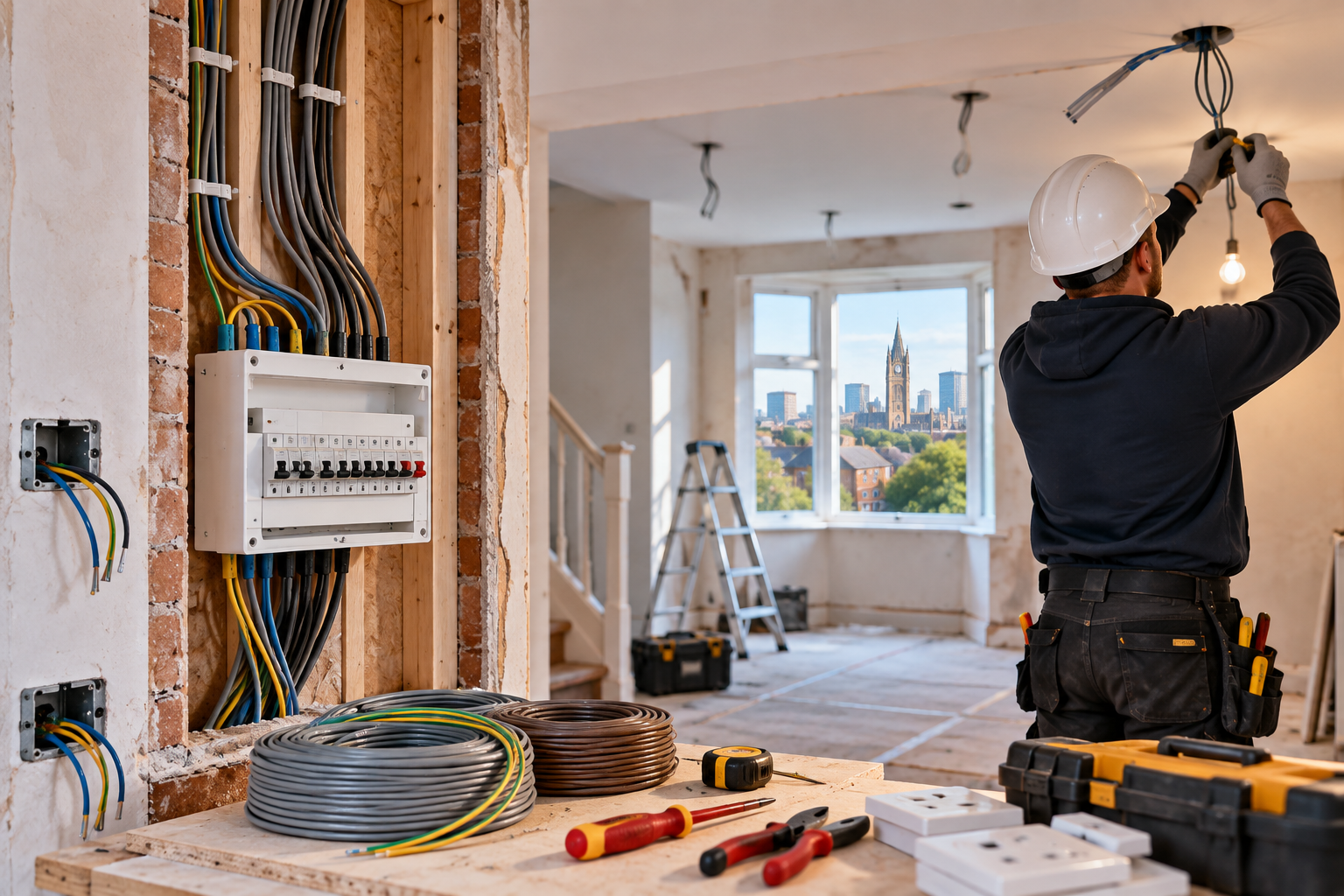
What to Expect When Rewiring a House in Manchester
Rewiring a house is a major electrical project, but knowing what to expect can make the process much easier. The work usually involves replacing old or unsuitable wiring, updating electrical accessories and ensuring the installation is properly tested.
If you are planning rewiring a house, it helps to understand how the work is organised, what may need to be moved or protected, and what happens when the installation is completed.
This guide explains the main stages of what to expect when rewiring a house, from the initial assessment to final testing and certification.
What to Expect Before Rewiring a House
Before work starts, the electrician should assess the existing installation and discuss the proposed work with you. This helps establish which circuits, accessories and wiring need attention.
The electrician may consider:
- Existing wiring and its condition
- Number and location of sockets
- Lighting requirements
- Consumer unit and circuit protection
- Earthing and bonding
- Future electrical requirements
- Access to walls, floors and ceilings
Good rewiring preparation can help reduce delays and make the project easier to manage.
If you are unsure how to prepare your property, your existing House Rewire Preparation Manchester page can provide more specific information.
What Is Involved in Rewiring a House?
So, what to expect when rewiring a house depends partly on the property’s size, layout and condition.
A typical rewire may involve removing or disconnecting sections of old wiring and installing new cables throughout the required circuits.
The work can include:
- Replacing old electrical cables
- Installing new sockets and switches
- Updating lighting circuits
- Improving circuit protection
- Replacing unsuitable accessories
- Making necessary connections
- Testing the completed installation
The exact scope should be agreed before work begins so you understand what is included.
How Does House Rewiring Affect Walls and Floors?
Access is one of the biggest practical considerations when what to expect when rewiring a house.
Cables may need to be routed through walls, floors, ceilings or other accessible areas. Depending on the construction of the property, some areas may need limited opening or lifting to provide access.
The amount of disruption varies between properties. A straightforward installation may require less access, while an older or more complicated property can involve additional work.
Discussing cable routes with the electrician beforehand can help you understand where access may be required.
What Happens to the Sockets and Switches?
During a rewire, existing sockets and switches may be removed and replaced as part of the new installation.
This gives you an opportunity to consider whether their current positions are still suitable. For example, you may want additional sockets in areas where modern electrical equipment is used.
If you need changes to your socket or switch layout, discuss them before the installation starts rather than after the walls have been finished.
For related work, see Socket and Switch Installation Manchester.
Will the Consumer Unit Be Replaced?
The consumer unit is an important part of the electrical installation because it houses protective devices for the circuits.
As part of what to expect when rewiring a house, the existing consumer unit should be assessed to determine whether it is suitable for the updated installation.
Depending on its condition and the requirements of the new circuits, replacement or an upgrade may be appropriate.
You can also review your Consumer Unit Replacement Manchester page for more information about this type of electrical work.
What Happens During the Rewiring Work?
Once the plan is agreed, the electrician can begin the installation.
The work is normally completed in stages, with cables and accessories installed according to the agreed layout. Existing electrical supplies may need to be disconnected while particular parts of the installation are being worked on.
The electrician may work through different areas of the property rather than completing everything at once.
The exact sequence depends on the building and the scope of work. This is why what to expect when rewiring a house can vary from one Manchester property to another.
Your House Rewire Process Manchester page can be used as an internal resource for the detailed stages involved.
How Much Disruption Should You Expect?
A house rewire can create some disruption because electricians need access to parts of the building.
You may experience:
- Temporary loss of power
- Furniture needing to be moved
- Access openings in some areas
- Dust or minor debris
- Temporary removal of sockets or switches
- Follow-up making-good work
The level of disruption depends on the property and how accessible the wiring is.
Planning rooms around the work can make the process easier, particularly if you are living in the property during the rewire.
For more specific guidance, see Rewiring a House While Living in It Manchester.
Can You Stay in the House During Rewiring?
Sometimes, but it depends on the size and complexity of the project.
A smaller or phased rewire may allow occupants to remain in the property, although there may be periods when electricity is unavailable in certain areas.
For a larger installation, temporarily staying elsewhere may be more practical.
If you intend to remain at home, discuss this with the electrician before the work starts so the project can be planned around your circumstances.
How Is the New Wiring Tested?
Testing is an essential part of what to expect when rewiring a house.
After installation, the electrical system should be inspected and tested to identify issues and confirm that the completed work is safe and functions correctly.
Testing may cover areas such as:
- Circuit continuity
- Insulation resistance
- Polarity
- Earthing arrangements
- Protective devices
- RCD operation
- Circuit connections
The electrician should provide the appropriate electrical certification for the work completed.
For further information, you can link to Electrical Safety Testing Manchester from this section.
Does a House Rewire Need to Meet NAPIT or Other Standards?
The important consideration is that electrical work should be completed by a competent electrician and designed and installed in accordance with the applicable requirements.
If choosing an electrician, you may also want to check their relevant qualifications, registration and certification.
NAPIT provides electrical schemes covering domestic electrical installation work and also has an Electrical Inspector Scheme covering EICR work.
For information about NAPIT’s electrical schemes and registration, see NAPIT Electrical Membership and Schemes.
You can also internally link this section to your NAPIT vs NICEIC Electricians Manchester page if the discussion naturally moves to choosing an electrician.
What Happens After the Rewire Is Complete?
Once the installation has been completed and tested, the electrician should explain the work carried out and provide the relevant certification.
It is useful to keep these documents because they provide a record of the electrical work completed at the property.
You should also check that:
- All agreed sockets and switches are installed
- Lighting points work correctly
- Circuit protection operates as expected
- Any agreed remedial work is complete
- Electrical certification has been provided
Understanding what to expect when rewiring a house does not end when the cables are installed. Final testing and documentation are an important part of completing the project.
How Can You Prepare for a House Rewire?
Good preparation can make rewiring a house less disruptive.
Before work begins, consider:
- Moving furniture away from work areas
- Removing fragile items
- Confirming socket and switch positions
- Discussing lighting requirements
- Planning temporary access
- Protecting valuable belongings
- Confirming the expected work schedule
- Asking what making-good work is included
It is also worth discussing any future electrical needs before installation starts. Adding suitable provisions during the project can be easier than making changes later.
What to Expect When Rewiring a House in Manchester
Every property is different, so the exact experience will depend on its age, construction, size and existing electrical installation.
However, the basic process is straightforward: assess the existing installation, plan the work, replace the required wiring and accessories, test the completed installation, and provide the appropriate certification.
Knowing what to expect when rewiring a house allows you to prepare your property properly and have clearer expectations about access, disruption and completion.
If your home’s wiring is old, damaged or no longer suitable for modern electrical demands, getting professional advice can help you determine whether a complete rewire or more targeted work is appropriate.
FAQs
The time depends on the size, layout and condition of the property. A larger or more complex house will usually require more time than a smaller property.
Some disruption is normal because electricians may need access to walls, floors and ceilings. The amount of dust and making-good work depends on the property’s construction and cable routes.
Not necessarily. Some projects can be completed while you remain at home, although certain areas may temporarily lose power. For larger projects, staying elsewhere may be more convenient.
Depending on the agreed scope, the work can include old cables, sockets, switches, lighting circuits and other unsuitable electrical components.
Yes. A rewire is a good opportunity to review your electrical layout and add sockets or lighting points where they are needed.
It depends on its condition and suitability for the updated installation. Your electrician can assess the existing consumer unit and recommend an upgrade or replacement where necessary.
The completed installation should be inspected and tested. The appropriate electrical certification should then be provided for the work carried out.
In many cases, yes, but there may be temporary power interruptions and restricted access to some rooms. Planning the work with your electrician can help reduce disruption.
Yes. House rewiring involves electrical installation work that should be planned, installed and tested by a suitably competent electrician.
NAPIT registration can help you check an electrician’s relevant scheme membership and credentials. You should also confirm that the electrician is suitably qualified and can provide the required certification for the work.
Leave a Reply